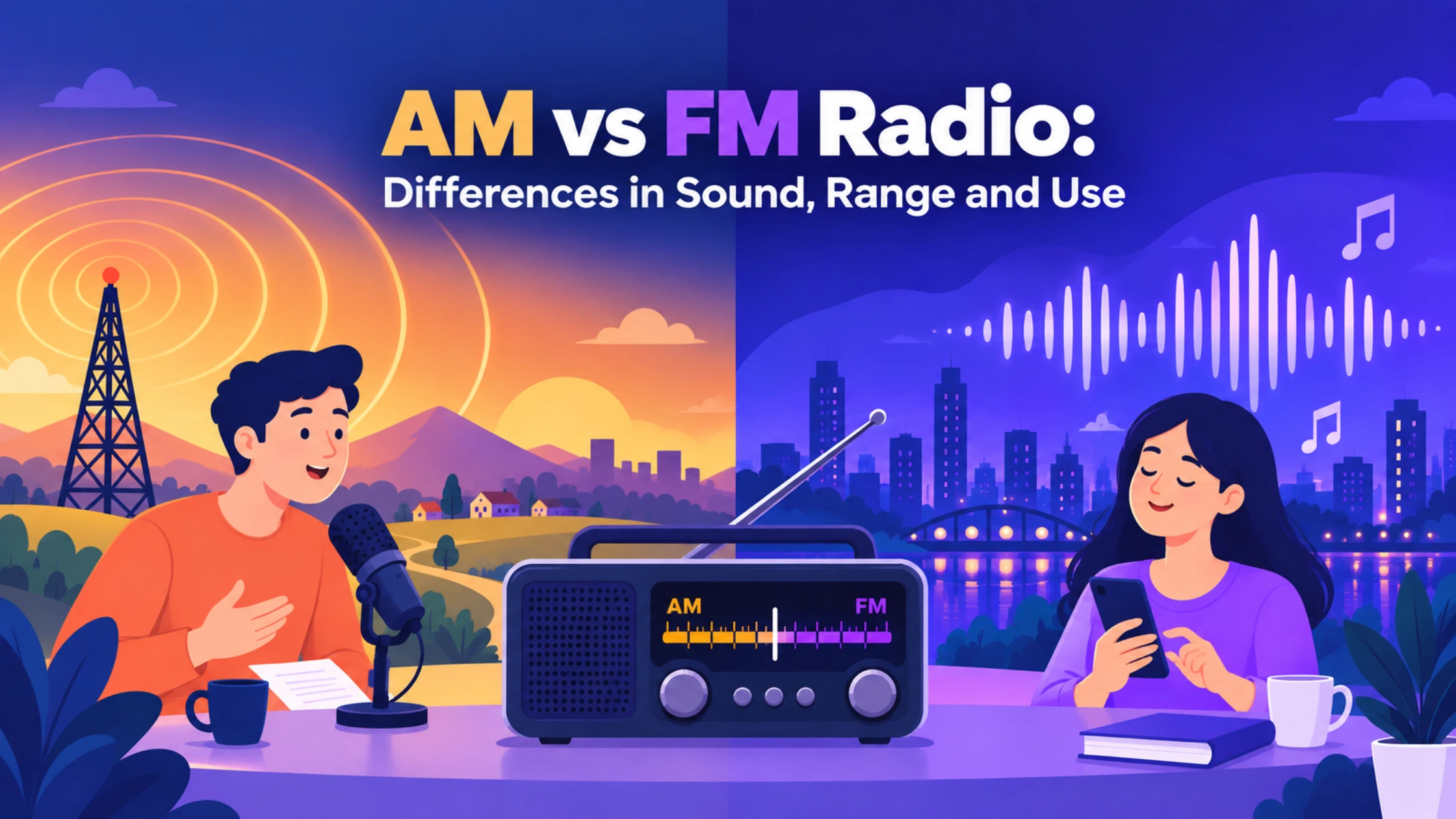
The difference between AM and FM is that AM transmits radio waves in different amplitudes while FM transmits radio waves at different frequencies. AM is more prone to the amplitude of the radio waves, while FM has a lower amplitude, so it offers a clearer sound quality, which is why FM is mostly used for broadcasting music.
Neither is automatically better in every situation. The right choice depends on what you want to hear, where you are and how strong the available signal is.
Internet radio works differently from both. Instead of receiving a broadcast frequency through an antenna, an internet-radio service streams station audio through an internet connection.
What do AM and FM stand for?
AM stands for amplitude modulation. FM stands for frequency modulation.
The words describe the part of the carrier wave that changes when sound is transmitted.
- With AM, the amplitude—or strength—of the carrier wave changes.
- With FM, the frequency of the carrier wave changes.
Your radio receiver detects those changes and converts them back into music, speech or other audio.
AM vs FM: a quick comparison
| Feature | AM radio | FM radio |
|---|---|---|
| Full name | Amplitude modulation | Frequency modulation |
| What changes | Signal amplitude | Signal frequency |
| Typical sound | Suitable for speech, but more vulnerable to noise | Usually clearer, especially for music |
| Common programming | News, talk, sports and local information | Music, entertainment, news and local programming |
| Practical coverage | Can travel long distances under suitable conditions | Often serves a more local or regional area |
| Interference | More affected by electrical noise | Less affected by many forms of amplitude noise |
| Nighttime behaviour | Some signals may travel much farther | Usually remains closer to line-of-sight coverage |
| Internet required | No, when using a conventional receiver | No, when using a conventional receiver |
These are general differences rather than fixed rules. Reception also depends on the station’s power, antenna, terrain, weather, local interference and broadcasting regulations.
How does AM radio work?
AM radio carries sound by changing the amplitude of a carrier wave. The carrier’s assigned frequency stays broadly fixed while its strength varies according to the audio being transmitted.
A receiver tuned to the station detects those variations and turns them back into sound.
The process is relatively simple, but it has a weakness: many forms of electrical interference also affect amplitude. Lightning, power lines, motors and electronic devices can therefore add buzzing, crackling or static to an AM signal.
That does not make AM unusable. Clear AM reception can work well for speech-based programming, where understanding the presenter is more important than hearing every musical detail.
How does FM radio work?
FM radio carries sound by varying the frequency of the carrier wave. Its amplitude remains broadly stable while the frequency moves slightly above and below the station’s assigned frequency.
Because the audio information is carried through frequency changes, FM receivers can reject many types of noise that mainly affect signal amplitude. This often produces a cleaner listening experience.
FM broadcasting also generally has room for wider audio bandwidth. That helps it reproduce music with more detail, and FM services often support stereo sound.
Why does FM usually sound better than AM?
FM usually sounds clearer because it is less sensitive to many common forms of electrical noise. Its broadcasting format also generally allows a wider audio range than AM.
These advantages make FM a natural choice for music stations. Listeners can usually hear more detail in vocals and instruments, with less crackling in areas that have a strong signal.
Sound quality still depends on several factors:
- Distance from the transmitter
- Buildings and hills
- The receiver and antenna
- Broadcast equipment
- Local interference
- The station’s audio processing
A weak FM signal can still become noisy or disappear. A strong AM signal can also sound clear enough for speech and everyday listening.
Which travels farther: AM or FM?
AM often travels farther than FM, but the reason is not simply the type of modulation. The frequency bands used by the two services behave differently.
AM broadcasting generally uses lower radio frequencies. These signals can follow the surface of the Earth as ground waves, allowing them to reach beyond the immediate horizon.
FM broadcasting uses higher frequencies that usually travel in a more direct, line-of-sight pattern. Hills, tall buildings and the curve of the Earth can limit reception. Transmitter height is therefore particularly important for FM coverage.
There is no single distance that applies to every station. A powerful station using a well-positioned antenna may cover a much larger area than a lower-powered service.
Why can AM radio travel farther at night?
Some AM signals can travel much farther after sunset because of changes in the ionosphere, a region of the upper atmosphere.
During the day, parts of the ionosphere absorb more of these signals. At night, that absorption decreases, allowing some AM waves to return towards the Earth. This is known as skywave propagation.
As a result, a listener may hear a distant AM station at night that is unavailable during the day.
The effect can also create interference when several stations use the same or nearby frequencies. Broadcasting authorities may therefore require certain AM stations to reduce power, change their antenna pattern or stop operating at night.
FM signals do not normally experience the same long-distance nighttime effect because they use much higher frequencies.
Is AM or FM better?
FM is generally better for high-quality music, while AM can be more useful for long-distance speech-based broadcasting. However, the content and signal strength matter more than the label alone.
Choose FM when:
- You want clearer music
- Stereo sound is important
- A strong local station is available
- You want less electrical interference
Choose AM when:
- You want news, talk or sports programming available on AM
- A station serves a wide geographic area
- You are travelling through places with fewer local FM options
- You want to try hearing distant stations after dark
In everyday use, people usually choose a station for its programmes rather than its modulation method. A useful news service on AM may be more valuable than a clear FM station playing content you do not want.
Is AM or FM better for music?
FM is normally the better option for music because it provides clearer audio and a wider frequency response. It is also better suited to stereo broadcasting.
AM can carry music, but its audio bandwidth is usually narrower and it is more vulnerable to noise. That can make music sound less detailed.
This does not mean every FM music station sounds the same. The original recording, station equipment, audio processing and your receiver all affect the final result.
Is AM or FM better for talk and sports?
Both formats can carry talk and sports, but AM has a long association with speech-led programming. Its potential coverage makes it useful for news, interviews, phone-in shows and match coverage across a wide region.
FM can also provide talk and sports programming with clearer audio. The actual format used depends on the broadcaster, available spectrum and local market.
Online streams add another option. An AM or FM broadcaster may make its programmes available online, helping listeners hear the station outside its normal terrestrial coverage area where streaming rights permit.
What frequencies do AM and FM use?
AM and FM operate in different parts of the radio spectrum.
AM broadcasting generally uses frequencies measured in kilohertz, while FM broadcasting uses higher frequencies measured in megahertz.
Exact broadcast bands and channel spacing differ by country. For example, the FM broadcast band in many places sits roughly between 88 and 108 MHz, but local regulations vary.
Listeners should use the frequency shown by the broadcaster for their specific city or region rather than assuming that one number works everywhere.
Is internet radio the same as FM radio?
No. Internet radio streams audio through the internet, while FM radio sends a terrestrial broadcast signal through the air.
An FM receiver uses an antenna to pick up a station within the signal’s coverage area. Internet radio uses Wi-Fi or mobile data to connect to an online stream.
This creates several practical differences:
- Internet radio can make stations available beyond their normal AM or FM coverage.
- Listeners can explore broadcasters from different countries.
- Streaming requires an internet connection.
- Mobile-data charges may apply without Wi-Fi.
- Stream availability can depend on the broadcaster and region.
- A local frequency is not required for an internet-only station.
Radio FM is a digital radio and podcast platform. It helps users discover internet radio stations by country, category and interest. It does not turn a phone into a traditional AM/FM receiver. When a terrestrial broadcaster provides an online stream, that stream may be available through an internet-radio platform.
Can you listen to AM and FM stations on a phone?
You can listen to many AM and FM broadcasters on a phone when they provide an online stream. In that case, the phone is receiving audio through the internet rather than directly tuning to the terrestrial frequency.
Some phones include FM receiver hardware, but support varies by model, manufacturer, mobile network and country. The feature may be disabled, and some devices require wired headphones to act as an antenna.
Direct AM reception is much less common in phones.
For a consistent mobile experience, many listeners use an internet-radio app. With Radio FM, users can search for available stations, save favourites and return to recently played content. An internet connection is generally required.
Does AM or FM radio use mobile data?
A conventional AM or FM receiver does not use mobile data. It receives signals directly through an antenna.
Listening to an AM or FM broadcaster’s online stream does use data because the audio reaches your device through the internet. The amount depends on the stream’s bitrate and how long you listen.
Using Wi-Fi can help avoid mobile-data use during longer listening sessions.
How has internet radio changed AM and FM listening?
Internet streaming has not erased the difference between AM and FM. Instead, it gives broadcasters another way to reach listeners.
A station may continue broadcasting on a local frequency while also offering an online stream. This can help people:
- Listen outside the station’s terrestrial coverage area
- Continue hearing a familiar station while travelling
- Discover broadcasters from other countries
- Listen on phones, computers, smart devices and connected cars
- Save stations for quicker access later
Broadcast and streaming rights can still create geographic restrictions. Finding a station online does not guarantee that every programme will be available in every country.
Frequently Asked Questions
What is the main difference between AM and FM?
AM carries audio by changing the amplitude of a radio wave. FM carries audio by changing its frequency. FM generally provides clearer sound, while AM can cover longer distances under suitable conditions.
What does AM radio stand for?
AM stands for amplitude modulation. The amplitude of the carrier wave changes according to the sound being transmitted.
What does FM radio stand for?
FM stands for frequency modulation. The carrier wave’s frequency changes slightly to carry the audio information.
Is AM or FM stronger?
There is no universal answer. Signal strength depends on transmitter power, antenna, distance, terrain and interference. AM often provides wider practical coverage, while FM can deliver clearer audio within a strong reception area.
Why does FM sound clearer than AM?
FM is less affected by many forms of amplitude-based electrical noise and generally supports wider audio bandwidth. This usually produces clearer speech and more detailed music.
Why does AM radio work better at night?
Some AM signals can travel through skywave propagation after sunset. Changes in the ionosphere allow the signals to return towards the Earth and reach more distant locations.
Is FM always used for music?
No. FM stations can broadcast news, talk, sports and other programming. Music is common on FM because the format generally provides better audio quality.
Does AM or FM need an internet connection?
A conventional AM or FM receiver does not need the internet. Listening through a website or radio app requires Wi-Fi or mobile data.
Can Radio FM receive a local FM frequency directly?
Radio FM streams online station feeds. It does not act as a hardware FM tuner. A local station may still be available if the broadcaster provides a supported internet stream.
Which is better: AM, FM or internet radio?
It depends on the situation. FM is useful for clear local broadcasts, AM can provide wider speech coverage, and internet radio offers global discovery when an internet connection is available.
AM, FM and Online Radio each have a place
The AM vs FM difference begins with how each format carries sound. AM changes signal amplitude, while FM changes frequency. That technical choice affects audio quality, interference and practical coverage.
FM is usually preferred for clear music. AM remains useful for talk, sports, news and long-distance reception. Internet radio adds another option by making available station streams accessible beyond the range of a local transmitter.
With Radio FM, listeners can explore online stations from different countries and categories, save the ones they enjoy and return whenever they want to hear them again.